shadow
BRUCE COCKBURN > News > 2023 > November

The Divine Sounds of Bruce Cockburn

By Steven Libowitz | November 21, 2023

Singer-songwriter Bruce Cockburn has released some 35 albums over his half-century career, enjoying enough success stateside to sustain making music, but also falling far short of the household name recognition of fellow Canadians like Joni Mitchell, Leonard Cohen, or even Gordon Lightfoot.

Now at 78, Cockburn – whose catalog includes such transcendent love songs as “This is One of the Best Ones” and polemics like “If I Had a Rocket Launcher” – has released a new album, O Sun O Moon, that shares how time takes its toll and slipping the mortal coil, but also invites us “out of the armor and into the now” and exclaims when “push comes to shove, it’s all about love.” He talked about all of it in a far-reaching conversation from his San Francisco home in advance of a solo show at the Lobero Theatre on November 18.

Q. Let’s just jump right in: How do you think your songwriting has changed and evolved over the years?

A. The perspective I have now is as an old guy, and you can probably trace how that’s changed. But not the point of view. Opinions might be different, but it’s more a deeper understanding because when I was young, I didn’t really understand anything… The songs have always just been a product of the time in my life that they appear – triggered by what I encounter that produces a strong emotional response, and what happens in my heart and mind.

Q. So is songwriting a way of processing, a method of making sense of the world and yourself, sorting that through in search of understanding, or more a way of communicating what’s internal?

A. I really only know after the fact… It’s not like I have something burning to get off my chest. But when I go for a long time without writing a song, I do feel choked up and confined. But it’s only with hindsight that I can see that a given song was processing something.

Q. You’ve been praised for the ability, more than most singer-songwriters, to balance between the outer and inner world, and the gritty details and the spiritual essence. Does that resonate? And if so, how do you navigate between them?

A. I’m aware of the degree to which being able to do that pleases me. It’s how I like to see things. I don’t think any good purpose is served by separating the day-to-day from the spiritual. I think they should mix, and they should influence each other, or at least the spiritual should influence the day-to-day. So it’s never very far from my line of thought, and therefore it shows up a lot in the songs no matter what I’m talking about.

Q. What about the permeability of the inner and outer worlds?

A. They’re not distinct at all. The phrase “my journey” sounds so grandiose, but I feel like it’s a thread that’s run through my life from the beginning of being self-aware that the membranes are permeable. The older I’ve gotten, there’s refinement of where I started. Early songs “Spring’s Song” and “Man of a Thousand Faces” I’m asking, “What is this? Where are we? What are we doing?” … I’ve always expressed my understanding of the need for a relationship with the divine. I feel like it’s clearer now, and the weight of it is more evident now.

Q. People tend to want to separate your catalog into political and personal songs. But you’ve shared that there’s no difference to you.

A. They’re all love songs. Even “If I Had a Rocket Launcher” – it’s a cry of pain, not hatred. I was expressing anger, but the last thing I wanted to do was go kill anybody. I wanted people to feel what it’s like to be in a situation like that, which is the point of art. Whether it’s something physical like a refugee camp under attack, or dealing with your own inner processes, you’re still singing your truth so that people might see things in new ways. Otherwise, why bother?

Q. How have you been able to maintain that equilibrium as our world has become even more polarized? You seem to still seek commonality, practice acceptance, and yearn for understanding. Someone else put it that you have a hope for a better world that you can’t shake.

A. It’s more necessary than ever to allow any worthwhile thoughts and feelings about that out to where they can be heard. It’s not in the dialogue that we see around us, which is so fragmented – everybody’s talking at the mirror. I think it’s really important now to offset that in any way available… When an idea for a song like “Us All” comes along I jump on it, because it means something bigger than some of the other ones, which all have their own significance and meaning and importance to me personally. I really want to get that out there and heard… Don’t get me wrong. I don’t have enough self-confidence to think of myself as influencing people, which is an utterly foolish goal anyway. Or maybe it’s a dodge, I don’t want to accept the responsibility. But what I see myself doing is sharing what I have experienced, felt, questioned, and understood with whoever’s willing to listen.

Q. Your new album has the thread of contemplating mortality, but you’ve been doing that for decades, going back at least to “Wondering Where the Lions Are,” which repeats the phrase “I’m thinking about eternity.”

A. It’s just part of the landscape… but you can’t help noticing that the horizon is getting closer all the time … My fear and my hope – the fear leads – is that when I get to that threshold and step over it, or I’m dragged over it, that I recognize the divine when it shows up. What that means in practical terms, I have no idea.

Credit: montecitojournal.net
|

Nearing 80, Bruce Cockburn angles into mortality on ‘O Sun O Moon’

‘The songs are written from the view of an old guy,’ says the legendary Canadian musician. ‘I invited people to notice.’
By Lou Fancher
November 16, 2023

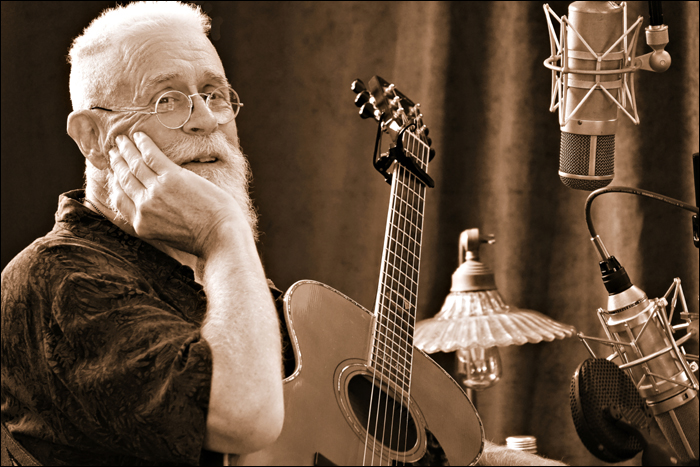
Bruce Cockburn 2023 photo Keebler

If there are albums that cause a person to think about time and tone beyond tempo and a voice’s timbre, Bruce Cockburn’s O Sun O Moon is one of them. Its 12 tracks open onto galaxies of contemplation, with the 78-year-old Canadian singer-songwriter-guitarist now based in San Francisco musing on topics from aging to climate change. Common humanity prevails—track “Orders” reminds that “Our orders said to love them all.” Another song, “Us All,” has Cockburn crooning, “Open the vein, let kindness rain/O’er us all/O’er us all/O’er us all.”

The Canadian Songwriters Hall of Fame musician, whose 22 gold and platinum records have sold nine million copies worldwide, continues his penchant on this 38th album for crafting complex lyrics in marvelously simple, guy-in-a-bar-style language. Their sophistication lies under the surface, with each line honed to sleek essentialism. Cockburn’s impeccable guitar playing is given at this point in his career, but cannot be overlooked—the production elucidates the acoustic elements of his voice and guitar—and on one track, dulcimer—along with those of a stellar group of guest artists.

O Sun O Moon might be Cockburn’s most personal album—even his most optimistic. Songs contemplate the end of life, and puzzle over human inability to care adequately for each other, ourselves, the planet. Lyrics sometimes float, delivering soft scents that seem carried by winds from long ago. Yet at other times, words explode with hard-truth vigor.

“Most optimistic? I’d say I have no idea,” says Cockburn in an interview with 48 Hills. The rest of his reply displays his typical, straight-off-the-cuff dry humor, followed by practical reflection.

“I’d have to go back and listen to them all. But no, I think Dancing In The Dragon’s Jaw was a pretty optimistic record. All the ’70s albums are like that, and it gets darker as time goes on. This new one is certainly more optimistic-sounding than You’ve Never Seen Everything. It’s always been back and forth for me. This album doesn’t have too much tragedy, other than ‘Colin Went Down To The Water.’ That’s specific to being in Maui, when a friend drowned in a scuba accident, but it’s not the kind of tragedy we see all around the world today. If not the most optimistic, this album is certainly one of the more optimistic.”

With two exceptions—the song about his friend and one about global warming, written with Inuk singer Susan Aglukark, Cockburn says O Sun O Moon‘s tracks aren’t inspired by real-life people or happenings. The claim is mildly disingenuous. “On a Roll,” the album’s first track acknowledges an aging body’s crumbling infrastructure, a clear reference to the substantial back pain that has Cockburn fighting to get and remain vertical each day. “But in my soul/I’m on a roll,” the song concludes. Cockburn insists the album is not so much disassociation from human loss and environmental devastation as it is attention to internal tunings that have long been present in his music.

“It was the greater focus I’ve had during the last few years: the spiritual side of things that previously has always been there. That’s always been a conspicuous part of the songs, but there’s a point in your life where you feel you gotta go deeper. These songs reflect that intention, and I have no way to measure how deep I’ve got [he laughs], but the songs reflect that process. ‘O Sun O Moon’ and ‘When the Spirit Walks In the Room’ are certainly about the spiritual side.”

After not writing songs for an extended period of time, Cockburn spent a summer month hanging out with friends and family in a house they had rented on Maui. “The songs came out of getting up early, before everybody else, and sitting on the porch and looking at scenery and playing the guitar. The imagery in those songs reflect that experience. It’s the essence behind the scenery that’s really what the songs are about. They’re not attempts to produce descriptive landscape.”

He refers to “Push Comes To Shove” as “a more straight-up love song,” and says “King of the Bolero” just “came out of nowhere. That song started with an idea that came in San Francsico and had sat around in his notebook for a while—and a memory about a comment someone once made about a man of considerable heft whose double chin wrapped “all the way round his neck.”

That song most surprised Cockburn, who adds, “but it’s like they’re all a surprise; ‘When the Spirit Walks In the Room’ came in hour. I see those things as such a gift. They feel like a surprise; the ones that have to be worked on and take more time, less so. ‘King of The Bolero’ is so utterly non-autobiographical. It was typical of me back in the day, and reminded me of songs on my first two albums, songs like ‘Happy Good Morning Blues.’ There’s a kind of lighthearted surrealism. How vivid it is surprises me. You don’t have to think about it too much. Once the picture is there, it’s just a matter of painting it in.”

The album’s one instrumental piece “Haiku” was written in Maui; its title came from the name of the little village he stayed in.

“It’s another in a long line of guitar instrumentals I’ve come up with over the years. They come from a different process because they’re not triggered by lyrics. They’re triggered by stumbling on something, usually on the guitar. Trying a new tuning and seeing what comes out, for example.” In the case of “Haiku,” he was “stumbling” on what became the first phrase of the piece; moving double stops over a drone bass Cockburn has used in lots of songs.

“It was, where can I take this? It just built up from that. I give myself some sort of jamming room in instrumental pieces like this that aren’t so folky. When I wrote it initially, it was, ‘What can I get the guitar to do here?’ Then when it was almost done, I thought it would be nice if it had a bossanova feel to it. If you’d heard the guitar by itself, your imagination wouldn’t necessarily have taken it in that direction, but that’s where it went to for me. I wouldn’t have minded a little more of bossanova, but what we got was good.”

Asked about messaging, Cockburn says, “I wasn’t thinking of messaging so much, as the stuff that’s on my mind isn’t exclusive to me. We’re all thinking about the same stuff, and the older we get, the more proximate that horizon becomes. Mortality’s never been off the radar for me, from the get-go. I’ve always been aware that life ends. If I think about the actual moment, it makes me nervous. But the concept does not. The older I get, the balance shifts; there’s some reconciliation between those two things. The songs are written from the view of an old guy. I invited people to notice.”

What does a song do? Willing to admit songwriting is indirectly a way of getting people to notice him and his perspectives, Cockburn makes it clear as to what his songwriting is not.

“It’s not about persuading people, it’s about observing, and wanting to share the observation. We’re seeing protests, counterprotests, horrible behavior all over the place. We don’t thrive in that atmosphere. It would nice if we could all just step back, so there is in the songs that underlying feeling. That said, it wasn’t like I was deliberately thinking I had to say something about spirit or manifestations of the divine. It’s just what came up.”

Cockburn’s about to embark on an extensive North American and world tour, which includes appearances December 1 and 2 at Berkeley’s Freight & Salvage. He says the most satisfying songs to play on the road are the new ones—“when I don’t screw them up.” “When You Arrive” is a gas, because he plays it as a sing-along.

“It cracks me up every night when I can hear a whole audience singing, ‘And the dead shall sing/To the living and the semi alive.’ People are bellowing it out and it’s really great,” he says.

The conversation ends with Cockburn saying he’s holding out not just to live for several more decades, but to reach his 500th birthday while still vertical—and writing songs. But before allowing him to return to his daily life (which includes picking his young daughter up from school), one question remains that the non-traditional Christian musician seems to have never been asked: about his favorite hymns. Also, would he most want to sing them during one’s final hours?

“One of them is partly a favorite by association: ‘A Closer Walk With Thee.’ You don’t hear it often these days, but I walked into church on a day before COVID when I wasn’t playing with the band. I came in and they were playing it. It was so cool to hear it as a swung song. It really worked. Another on is ‘Leaning on the Everlasting Arms.’ It comes at the end, and actually runs all the way through, the Coen Brothers’ movie True Grit. They use Iris Dement’s version of it in the soundtrack. It’s beautiful, partly because of the harsh context in which it comes up in the film. It’s a favorite of mine. I’m trying to get my daughter to learn it.

“‘Peace in the Valley,’ I’ve loved that ever since I heard Elvis Presley do it in the ’50s. I actually do know how to play that one. If I get around to doing my imaginary album with the writing of other people’s stuff, that’ll be on it. It’s a Thomas A. Dorsey song and he wrote it for Mahalia Jackson. Her version, the one they recorded, sounds like they did it the way they felt they should. Maybe I’m biased because I’m so attached to the original version I heard, which was Elvis’. I’d have my daughter do that with me too, because she’d be more reliable.”

BRUCE COCKBURN plays December 1 and 2 at Freight & Salvage, Berkeley. More info and tickets here and here. Purchase O Sun O Moon here.

Credit: 48hills.org

Photo: Daniel Keebler


Stalwarts Of Music with Aditya Veera interview with Bruce Cockburn

Aditya Veera (from India) interviewed Bruce on July 15, 2023.

Stalwarts Of Music with Aditya Veera (@adix70) ft. Bruce Cockburn, the much-awaited interview is out now on:
Youtube – https://youtu.be/zFtD-caDnDI?si=gAp3j98flSWIGsJY

Premiered Nov 8, 2023
This episode of Stalwarts Of Music with Aditya Veera, Season 2, features the celebrated musician Bruce Cockburn as the guest. Bruce, a renowned Canadian singer-songwriter and guitarist, has earned global recognition throughout his extensive career, marked by numerous awards, including 13 Juno Awards. He holds a place in the Canadian Music Hall of Fame and the Canadian Songwriters Hall of Fame.

Aditya Veera delves into Bruce’s background, starting with his earliest musical influences shaped by exposure to classical, Broadway tunes, and pop music. However, the emergence of rock and roll in the late 1950s significantly impacted his musical preferences. In his teenage years, he explored classical music and self-studied jazz composition and musical theory.

The conversation navigates through various aspects of Bruce’s life, including a remarkable encounter with Ali Farka Touré in Timbuktu, Mali, during a documentary shoot about desertification. Bruce vividly recalls a memorable, albeit linguistically limited, collaboration with Touré during a performance.

Bruce’s environmental activism, reflected in his music, becomes the focal point. He discusses the intention behind songs like To Keep the World We Know, addressing climate change and wildfires. His insights emphasize the emotional core of his songwriting, aiming to raise awareness and possibly serve as rallying cries for environmental concerns.

The interview progresses to discussions about global efforts to address environmental issues, emphasizing the complexity of balancing economic prosperity with sustainability. Bruce recognizes the reluctance of individuals to attribute human causes to climate change and underlines the importance of imagination and will in decision-making.

They delve into the symbolic and emotional resonances within Bruce’s music, particularly the song Colin Went Down to the Water, inspired by a friend’s tragic drowning incident in Maui. Bruce’s creative process involves channeling emotional experiences into relatable songs.

The conversation shifts to his song Pacing the Cage, rooted in mortality and aging, aiming to celebrate life despite the inevitability of mortality. They discuss his guitar style, influenced by blues musicians, and how arthritis is prompting him to reconsider the guitar parts in his songs.

Spiritual and existential themes within Bruce’s music and his beliefs become the focus. He discusses his explorations of different spiritual paths, emphasizing the importance of personal relationships with the divine and transcending cultural limitations in spiritual expressions.

Aditya explores Bruce’s hopes for his music’s timeless quality and its potential to resonate with future generations, akin to the lasting impact of old blues musicians. Bruce addresses the sensitive political themes in his music and his belief in portraying his truths, even if they might be contentious.

The interview encompasses Bruce’s experiences in diverse cultural settings worldwide, touching briefly on his limited visits to India. He also reflects on overcoming physical challenges and the influence of his comfortable upbringing on his perspective.

The final segment introduces a Rapid Fire round, providing insights into Bruce’s preferences and thoughts, culminating with his essential qualities as a singer-songwriter and his humble wish to be remembered positively for his contributions to the art.

In essence, the interview presents Bruce Cockburn’s multifaceted journey, emphasizing his musical evolution, environmental activism, spiritual explorations, and his resilient, authentic approach to life and art. His desire to leave a positive impact through his music and contributions is central throughout the conversation.


The interview live stream will later be available on all major audio streaming platforms (Apple Podcasts, Spotify, Amazon Music, iHeart Radio & many more). You can head out to the podcast section at www.adiveera.com to watch more interviews or click here – https://linktr.ee/adityaveerapodcast
Do subscribe to Aditya Veera’s YouTube channel – https://www.youtube.com/channel/UCo6o9P_k7HxkPDdb4gEUJkg
Leave a review on Spotify, and Apple Podcasts and spread the love 🙂

|